
Underbrushing is the job most wooded Texas properties actually need: clear everything under the canopy, keep the trees. Here is what the word means on the ground, what it costs on documented jobs, and what grows back.
Underbrushing, or underbrush clearing, is removing the understory of a wooded tract while leaving the canopy trees standing: yaupon, greenbrier, privet, saplings, dead wood and small hardwoods under a few inches, ground into mulch in place with a forestry mulcher that works between the trees. The result is a wooded property you can see through, walk through and use, with the shade intact.
It is the opposite of clearing a tract. Full clearing takes everything to the ground. Underbrushing keeps the pines, the oaks, the pecans and the elms, and takes out the layer under them that has made the woods a wall. On the east side of Texas, from Magnolia and Conroe up through the Piney Woods and across the Post Oak Savannah, that layer is mostly yaupon holly, and a yaupon thicket left alone for fifteen years is dense enough that you cannot see thirty feet into your own property. The brush clearing vs underbrush clearing guide draws the line between the two jobs in more detail; this page is about the underbrushing job itself.
A wooded lot with the understory out is a park. You can see the property line, walk to the creek, put a trail through, graze under the trees, or stand on the porch and see deer instead of a green wall. Most of the underbrushing calls we get around Houston, Magnolia and Conroe are exactly this: a homeowner with two to ten wooded acres who wants to use them.
The understory is the ladder fuel that carries a ground fire up into the crowns. Take it out and a fire stays on the ground where it can be stopped. Around a house in the pines this is the single most useful wildfire measure there is, and it does not cost you a single tree.
Yaupon and privet compete with the canopy for water and shade out every oak and pine seedling. Underbrushing lets the trees you want breathe and lets the next generation of them start. It is what a healthy East Texas woodland looked like before fire was taken out of the system.
Deer travel edges and openings. Underbrushed woods with lanes and clearings through them hold more game and let you see it. Leaving strips of thick cover along drainages keeps the bedding areas while opening the rest.
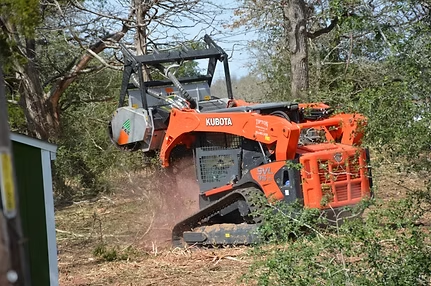
Underbrushing is skid steer mulcher work. The dedicated high horsepower mulchers that clear a pasture are too big to work between trees on a tight lot; the compact machine with a mulching head goes down the rows, around the trunks, and grinds the understory to a mulch layer a couple of inches deep. Nothing is hauled, nothing is burned, and the mulch stays as erosion control and moisture cover under the trees. The operator stays off the root zones of the keeper trees and does not bark the trunks, which is the difference between an underbrushing job and a damaged woodlot, and it is why the machine matters less than who is in it.
What comes out: yaupon, privet, greenbrier, dewberry, saplings, deadfall and small trees under about four to six inches, depending on what you want kept. What stays: every canopy tree you flag, and usually the understory strips along creeks. On a typical wooded lot the skid steer covers half an acre to three quarters of an acre a day, which is why most two to four acre underbrushing jobs are a one or two day job. Our equipment guide covers the machines, and the brush clearing services page covers the service across Texas.

Underbrushing is priced by the machine day: $3,000 per day for the skid steer mulcher, transport included. The day count comes from acreage and how thick the understory is. Documented jobs:
Somerville, 3 acres of brush and underbrush clearing: one day, $5,000 to $6,000. Paige, 4 acres of brush and underbrush clearing: one day, $5,000 to $6,000. Elgin, 4 acres of selective clearing and yaupon removal: one day, $4,000 to $5,000. Universal City, 6 acres of brush and underbrush clearing: two days, $9,000 to $10,000.
Divide those out and underbrushing on a wooded lot runs roughly $1,250 to $2,000 per acre on the small jobs, with the per acre number dropping as the acreage grows because the machine day is the fixed cost. The cost to clear land page has the full breakdown by tract size across 38 documented jobs.
Season. Underbrushing works in any month. Yaupon and privet are evergreen, so there is no waiting for leaf drop to see what is there, and winter work has the advantage of no snakes, no ticks and firm ground. The only real constraint is wet ground: a saturated East Texas lot ruts under a machine, and we push the start date rather than tear it up. Spring and fall fill up first; summer usually has the most open calendar. The full seasonal calendar is in the best time of year to clear land in Texas.
Regrowth. Here is the honest part. Yaupon, privet and greenbrier all resprout from the root after mulching. Underbrushing gives you two to three years of open woods, and then the understory starts back. The fix is a maintenance pass at that point, which is fast and cheap because the regrowth is small and the ground is already open, and a lot that gets a light pass every two or three years stays open indefinitely. Grubbing the roots out is not practical under a canopy without damaging the trees you kept, and we do not do chemical treatment, so the maintenance pass is the answer. The after forestry mulching guide covers the first year in detail.
Where we do it. Underbrushing is the standard job on the east side of the state. See the Houston, Magnolia and Conroe pages for the local ground, and the land clearing in Texas page for everywhere else.
Clearing the understory of a wooded tract, the yaupon, greenbrier, privet, saplings and dead wood under the canopy, while leaving the canopy trees standing. It is done with a forestry mulcher that works between the trunks and grinds the understory into mulch in place.
Roughly $1,250 to $2,000 per acre on documented two to six acre jobs, priced at $3,000 per machine day for the skid steer mulcher with transport included. Bigger tracts run less per acre.
A skid steer mulcher covers half an acre to three quarters of an acre of understory a day. Most two to four acre lots are one or two days.
Not when it is done right. The operator stays off the root zones and does not bark the trunks, and removing the understory takes competition off the canopy trees. A careless operator can damage trees, which is why experience matters more than the machine.
Yes. Yaupon, privet and greenbrier resprout from the root. Expect two to three years of open woods, then a light maintenance pass, which is fast and inexpensive. A tract on a two or three year cycle stays open indefinitely.
Any dry month. Winter has firm ground and no snakes or ticks; summer has the most open schedule. The only constraint is saturated ground, which we wait out.
No. Brush clearing usually means taking a tract to the ground. Underbrushing keeps the canopy and removes what is under it. The brush clearing vs underbrush clearing guide covers the difference.
A few photos from the edge looking in, and the acreage, is enough for a day count and a real number. Trees stay, understory goes, nothing leaves the property.