
They sound like the same job. They are not. One resets the whole tract, the other clears out what grows underneath and leaves your trees standing. Picking the right one changes the machine, the price, and what your land looks like for the next decade.
Brush clearing removes the woody growth on a tract: thickets, scrub, saplings, and, where you want it, everything else. Underbrush clearing, also called underbrushing, is the selective version: the machines work beneath and between your mature trees, grinding out the yaupon, greenbrier, cedar saplings and scrub while every oak, elm and pine you want stays rooted and untouched. Full brush clearing suits land being reset for pasture, building, or a fresh start. Underbrushing suits land you already like, that just needs to breathe.
Both are done by forestry mulching on our jobs: the growth grinds into a mulch layer where it stood, nothing is piled or burned, and the ground is usable the day the machine leaves. Our brush clearing service page covers the full menu, and the equipment guide shows every machine mentioned below.
Choose full clearing when the land has a new job to do. A tract going to pasture needs the whole thicket gone so grass gets the sunlight. A homesite needs clean ground for the pad, the septic field, and the drive. Fence lines need a true corridor, not a trimmed hedge. And land that has gone feral, the kind you cannot walk into, usually cannot be saved selectively because there is nothing worth selecting yet.
Expect the mulch layer to hold your topsoil through the first storms, and expect regrowth pressure: mesquite and yaupon resprout from the root crown, so a one-time clear without a follow-up plan slowly reverts. That is honest machine work, not a sales line. Where the roots have to go too, for a pad or a plowable field, clearing gets paired with grubbing.
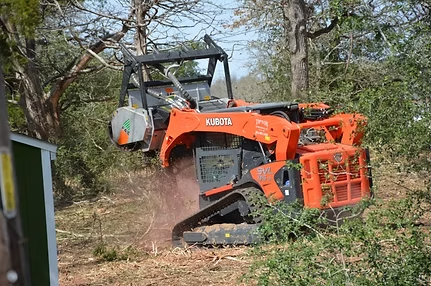

Underbrushing is for land you bought because of the trees. Hunting tracts get their sight lines and shooting lanes back while the canopy that holds the deer stays. Oak-country homesites go from impenetrable to park-like. Pine acreage in the Conroe and Montgomery counties gets its understory knocked back before it becomes a fuel load. The skill is in the operator: threading a machine between trunks all day without barking a single keeper.
It is also the right answer for reclaiming overgrown pasture. If grass once grew there, it usually still can: grind the invaders, let the sunlight back in, and the seed bank does surprising work by the next spring. Where cedar is the invader, which in the Hill Country it usually is, our cedar clearing and removal page covers that fight in detail, including why ashe juniper, unlike mesquite, does not resprout once cut.
Same machines, same published rates, different pace. Skid steer mulching runs $3,000 a day with transport included; a high horsepower dedicated mulcher runs $4,000 a day plus transport. Full clearing on open scrub moves fastest. Underbrushing runs slower per acre because the operator is picking a path around every tree you are keeping, and dense old thicket slows everything. That is why we quote from photos of your actual understory instead of a flat per-acre promise; the cost to clear land guide shows the math with worked examples, and our documented projects publish real acreage, days, and costs for both kinds of job.
No. A brush hog is a rotary mower that shreds light growth and leaves ragged stems it must drive over first. A forestry mulcher grinds woody brush and saplings to the ground into real mulch, handles material a hog cannot touch, and works around keeper trees without hitting them. The brush hogging vs forestry mulching guide has the full comparison.
Some of it wants to. Mesquite and yaupon resprout from the root crown, so plan on a maintenance pass every few years or targeted grubbing where you need permanence. Ashe juniper cedar does not resprout from a cut stump, which is why cedar work holds so well.
Yes, that is exactly what underbrushing is. The machine works between trunks and under canopies, and root systems stay undisturbed because nothing is dug or dragged. Ask us about oak wilt timing in your county when we quote; we flag pruning-adjacent risks honestly.
Mulch the invading brush, keep the trees you want for shade, and let sunlight reach the old grass. Most pastures show grass again the next growing season. Heavy mesquite country sometimes justifies grubbing the worst stands so the reset lasts.
Published rates: $3,000 a day for skid steer mulching with transport included, $4,000 a day plus transport for a high horsepower dedicated mulcher. Photos of your brush get you a same-day quote.
And if your brush is cedar, the cedar mulch guide covers what the ground-up result actually does for your land.
Text us photos of the growth. We will tell you whether it is a full clear or an underbrushing job, what machine we would send, and what it costs. 7 days a week.